Summary
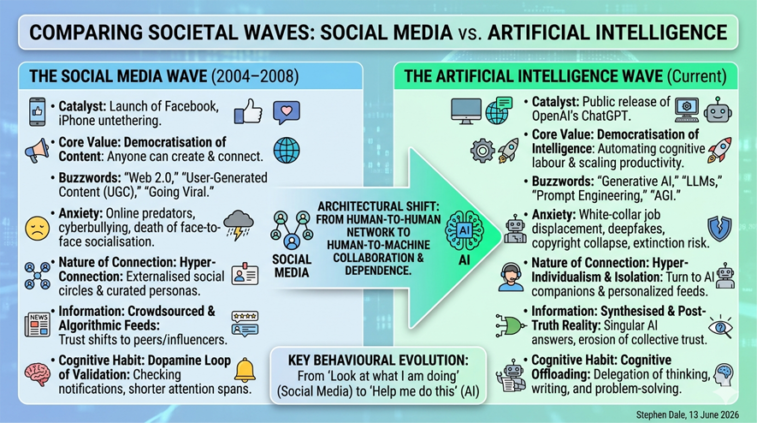
This post compares the societal consequences of the social media wave of 2004–2008 with those of the emergent artificial intelligence wave. Its central argument is that both technologies began as novel, fast-moving innovations before quickly becoming embedded in everyday life, thereby reshaping behaviour, institutions, and economic expectations at scale.
The comparison highlights three principal conclusions: –
First, both waves were driven by a democratising promise: social media broadened participation in content creation and distribution, while AI is broadening access to cognitive capability and automated production.
Secondly, each wave triggered a corporate and investment rush, characterised by inflated expectations, rapid market entry, and experimentation ahead of proven long-term business models.
Thirdly, the nature of public concern has shifted from anxieties about social connection, online conduct, and media fragmentation towards concerns about labour displacement, synthetic information, trust, and the erosion of human judgement.
The strategic implication is that AI should be understood not simply as another technology cycle, but as a transition in the relationship between people and digital systems.
Whereas the social media era centred on human-to-human visibility and interaction, the AI era is increasingly defined by human-to-machine collaboration, delegation, and dependence. For decision-makers, the key issue is therefore not whether AI will become normalised, but how its adoption will shape productivity, trust, skills, and social behaviour over time.
| Metric / Dimension | The Social Media Wave (2004–2008) | The Artificial Intelligence Wave (Current) |
| The Catalyst Event | The launch of Facebook (2004) to the public/colleges, the acquisition of MySpace by News Corp (2005), and the launch of the iPhone (2007) which untethered social media from the desktop. | The public release of OpenAI’s ChatGPT (late 2022), which made powerful Large Language Models (LLMs) accessible to anyone with a web browser. |
| The Core Value Proposition | Democratisation of Content: Anyone can be a creator, connect globally, and share their life in real-time. “The world is getting smaller and more connected.” | Democratisation of Intelligence: Anyone can automate cognitive labour, generate high-quality assets (text, code, art) instantly, and scale productivity exponentially. |
| Defining Cultural Buzzwords | “Web 2.0,” “User-Generated Content (UGC),” “The Social Graph,” “Going Viral,” and “Crowdsourcing.” | “Generative AI,” “LLMs,” “AGI (Artificial General Intelligence),” “Prompt Engineering,” and “Compute.” |
| The Corporate “Gold Rush” | Every legacy brand rushed to build a Facebook page, a corporate blog, or a profile on Second Life to prove they were “forward-thinking.” | Every legacy company is rushing to integrate an “AI copilot,” implement chatbots, and sprinkle “AI-powered” features into their existing software. |
| Venture Capital Sentiment | Insane valuations for companies with massive user growth but zero revenue model (e.g., Yahoo offering $1 Billion for a young Facebook; MySpace selling for $580 Million). | Astronomical valuations for AI start-ups based on compute power and talent grabs, often before they have a sustainable enterprise business model. |
| The “Doomsday” Anxiety | Societal & Psychological: Fears of online predators, cyberbullying, the death of face-to-face socialisation, and the destruction of the traditional music/news media industries. | Existential & Economic: Fears of mass white-collar job displacement, the proliferation of deepfakes/misinformation, copyright collapse, and the theoretical “extinction risk” of rogue AGI. |
| The Architectural Shift | Moving from static, read-only HTML pages (Web 1.0) to dynamic, read-write, database-driven social feeds (Web 2.0). | Moving from deterministic, rule-based software (if/then code) to probabilistic, generative systems that learn from patterns in data. |
The Takeaway
The most significant parallel between these two eras lies in the way each technology moved from the fringe to the everyday. In 2005, explaining to a business executive why an organisation needed a “Twitter strategy” would have sounded faintly absurd. Today, social media is simply part of modern life.
We are currently in the chaotic, formative phase of AI, echoing the social media landscape of the mid-2000s. Many of today’s AI start-ups will almost certainly fail, just as MySpace, Digg, and Delicious did; however, the underlying technology is already reshaping how the world functions.
An analysis of the impact on social behaviour reveals a profound shift: social media changed how we connect with one another, whereas AI is changing how we relate to information, reality, and the very concept of intelligence.
Between 2004 and 2008, the focus was on the “human-to-human” network. Today, the challenge lies in navigating the “human-to-machine” relationship.
| Behavioural Dimension | The Social Media Wave (2004–2008) | The Artificial Intelligence Wave (Current) |
| The Nature of Connection | Hyper-Connection: Externalised social circles. People shifted from local, physical communities to global, digital “friends” and “followers,” creating the era of the curated online persona. | Hyper-Individualism & Isolation: Internalized interaction. People increasingly turn to AI companions, personalized tutors, and custom-tailored feeds, potentially outsourcing human companionship to responsive, non-judgmental software. |
| Information Consumption | Crowdsourced & Algorithmic Feeds: We stopped looking at static homepages and started consuming chronological, user-generated content. Trust shifted from institutional gatekeepers (news anchors) to peers and “influencers.” | Synthesised & Post-Truth Reality: We are moving away from browsing search results to receiving singular, AI-generated answers. The blurring of real vs. synthetic media (deepfakes, AI voice clones) has eroded collective trust in what we see and hear. |
| Communication Style | Brevity and Public Performance: The rise of short-form text, status updates, and photo sharing. Communication became performative, designed for an audience to “Like” or comment on. | Prompting and Co-Creation: Communication is becoming transactional and collaborative. Humans are learning to communicate via “prompts,” treating a machine as a thought partner, ghostwriter, or sounding board. |
| Cognitive Habits & Attention | The Dopamine Loop of Validation: The constant urge to check notifications, leading to shorter attention spans and a psychological dependency on external social validation. | Cognitive Offloading: Delegation of critical thinking, writing, and problem-solving to AI. This risks the atrophy of certain skills (e.g., basic writing, research) in exchange for high-level curation and editing. |
| Status and Social Capital | The “Follower” Economy: Social status became quantifiable. Your social worth in digital spaces was measured by your subscriber count, friends list, and engagement metrics. | The “Leverage” Economy: Status is shifting toward capability and output. Social capital belongs to those who can leverage AI to produce massive amounts of work, art, or code individually—the “solopreneur” mindset. |
| The Psychological Anxiety | FOMO (Fear of Missing Out): Chronic envy driven by watching other people’s highlighted, idealized lives, leading to a spike in youth anxiety and loneliness. | FOBO (Fear of Becoming Obsolete): Existential dread regarding professional identity, worth, and usefulness, combined with an underlying confusion about what makes human consciousness unique. |
The Behavioural Evolution
If one considers the broader trajectory, the two eras are closely linked. The social media period conditioned people to live through digital screens and to surrender vast quantities of personal data voluntarily. That behavioural shift, in turn, helped to produce the large-scale datasets required to train today’s AI systems.
In effect, we moved from “Look at what I am doing” (social media) to “Help me do this” (AI).
I’ll finish here because I’m not very good at predicting the future. Generative AI is already here, Quantum Computing is offering almost limitless computing power (subject to available energy), Artificial General Intelligence (AGI or singularity) is somewhere on the horizon. Is the future bright? One thing’s for sure, expect a lot more hype before reality dawns!

Be First to Comment